Introducing ane: A language server-aware chord-based terminal code editor (for humans and agents)
TL;DRaneis a terminal code editor that combines a new chord grammar with language servers to allow both human developers and code agents to efficiently explore and edit source code -ane execlets agents and scripts make precise reads and edits, whileane’s TUI editor lets developers fly through code.anechords are simple and predictable, and language servers + tree-sitter make for a pleasant experience. Give it a try here.
I've been writing code alongside AI agents for long enough that I can see where they tend to waste time. The agents are good at knowing what to change. The problem is they suck at exploring and editing source code files efficiently — they end up reading an entire file to understand one function, and then either re-write it wholesale, or uses cryptic sed commands. That burns a lot of time and tokens on context that doesn't matter.
Code editors thus far generally weren't designed with agents in mind. They were designed for humans who have a cursor, a screen, and a keyboard. So agents have to resort to overly broad exploration and blunt, imprecise edits.
I started building ane for two reasons. First is that the idea for ane's chord system has been burning a hole in my brain for over 2 years, having thought through how it would work over many iterations in a note on my phone. The second is to fix those inefficient agents by helping them be more precise and stop wasting tokens reading and generating text they don't need to. ane is a terminal code editor with a language-aware structured chord system — one that works equally well for a human typing in a TUI and an agent calling a CLI command.
Install:
curl -s https://prettysmart.dev/install/ane.sh | shThe installer detects your platform and puts ane on your PATH. If you prefer cargo, mise, or building from source, see the README.
The core idea is chords+LSP. A chord has four parts: action, positional, scope, component. For example:
cifc— Change Inside Function Contentsdtle— Delete To Line Endjnsn— Jump Next Struct Nameyefs- Yank Entire Function Self
An agent executing ane exec --chord "cifc(target:render, value:'todo!()')" src/ui.rs (to ChangeInsideFunctionContents for function render) gets back a unified diff of what changed. The agent doesn't need to read the full file first, and then again after. It probably won't need to send the whole file into the LLM in the first place. It names the function and states the new body. That's it.
For your code project, ane init claude (or codex, gemini, opencode, and a few others) drops a skill file into the right place and teaches the agent the chord grammar — in as few tokens as possible - so your agent becomes fluent quickly.
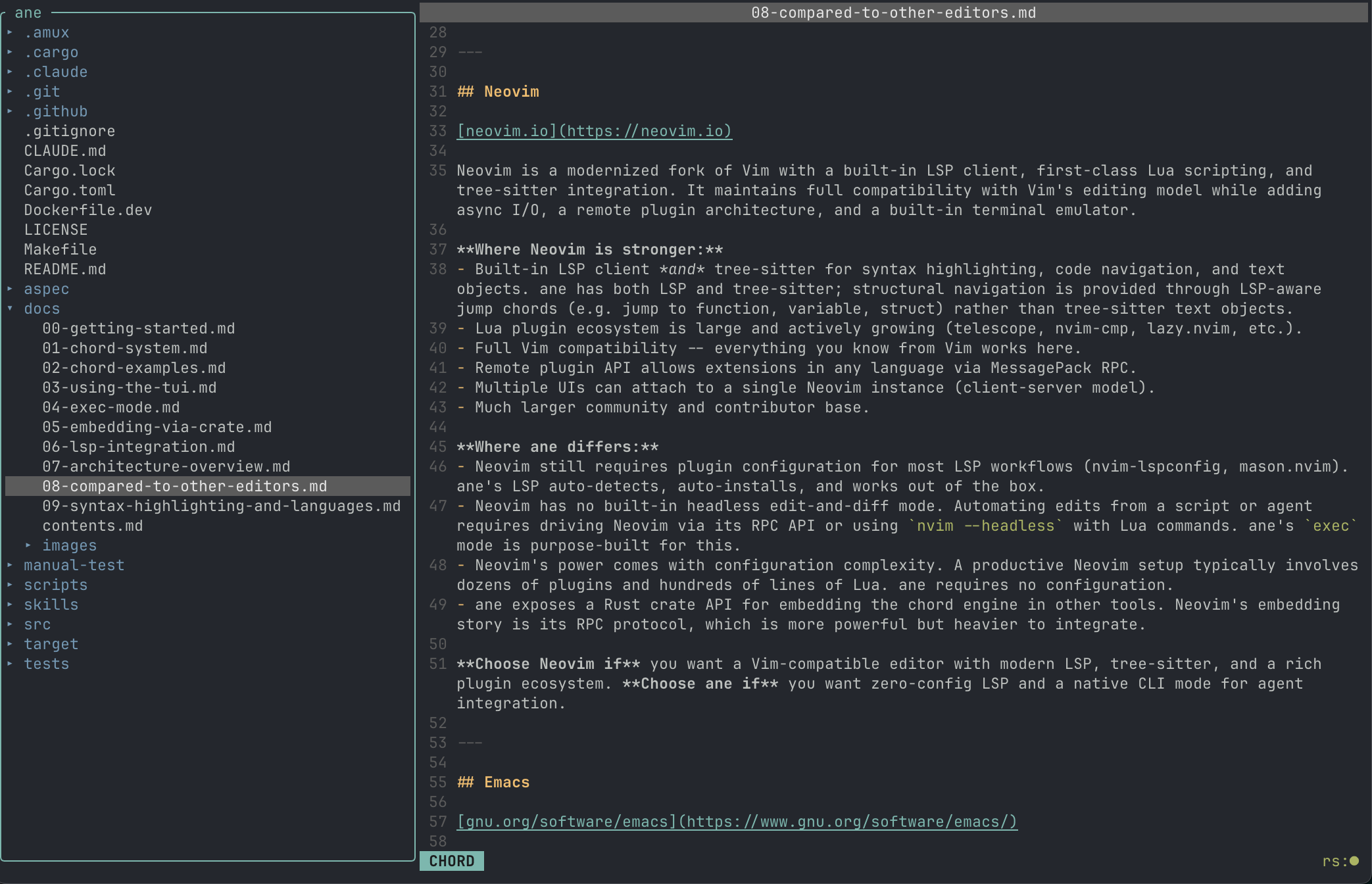
For humans, the editor TUI opens with a file tree and two modes: Chord mode for structured edits and Edit mode for direct typing. Short-form chords auto-execute when the cursor is sitting inside a recognized construct — type cifc and if your cursor is in a function, it executes immediately without pressing Enter. Chord history is a Ctrl-R away. Ctrl-E to switch between edit and chord mode, Ctrl-T to toggle the tree open/closed, Ctrl-S to write an edited buffer to disk, Ctrl-C twice to exit.
There is absolutely no configuration files, plugins, or options whatsoever yet, and that's intentional while I work to completely nail down the chord engine, language server integration, and code agent usability. Those things may come eventually, but for now I'm focusing on what makes ane unique.
Language servers are integrated by default: rust-analyzer, gopls, vtsls, basedpyright. They start in the background automatically so you can start editing immediately — line, buffer, and delimiter-scoped chords work without waiting for LSP readiness, and LSP-dependent chords (targeting functions, variables, structs, etc.) wait automatically. If the server isn't installed, ane offers to install it. tree-sitter provides syntax highlighting immediately on open, then LSP semantic tokens layer on top once the server is ready.
In addition to the CLI and TUI, ane-editor is available as a Rust crate that includes the chord engine, LSP engine, and everything else an agent harness would need to use ane's capabilities directly, so you can make your own custom agent harnesses more efficient at code editing.
This is an early release — there are chord components, languages, features, and polish still to come, and the TUI has room to grow. That said, it's my daily driver editor already, and the exec mode is what my code agents are already using to edit ane and amux. I'll be iterating on it pretty rapidly while I take a short break from amux development for a week or two.
Source and issues at github.com/prettysmartdev/ane. More at prettysmart.dev. Feedback, bug reports, and PRs are welcome.