I created a squad of agents to do all the boring work for me (awman v0.12 is out)
Much of my day building software is not the fun, interesting stuff like writing a new feature or working on an interesting performance optimization. It's the issue triage, dependency and pipeline management, PR merge conflicts, and the work item that needs a rough plan before anyone else can pick it up. Each thing takes only a few minutes, but together they eat up significant chunks of my day. Even with the multiplicative effort of parallel agents, the thing I actually wanted to build often gets pushed down the stack while I ensure the "glue work" gets done.
Agents have taken on huge amounts of complex software development for a while now, but every one of them requires that I kick things off with a prompt or a spec (which interrupts some other line of thinking and forces a context switch). My goal with awman v0.12 was to drastically reduce the amount of time I need to spend thinking about procedural glue work throughout my day.
v0.12 introduces awman squad: a group of agents that are always looking out for you, taking on the repetitive work as it shows up so your attention stays on the things that matter.
# install or upgrade
curl -s https://prettysmart.dev/install/awman.sh | sh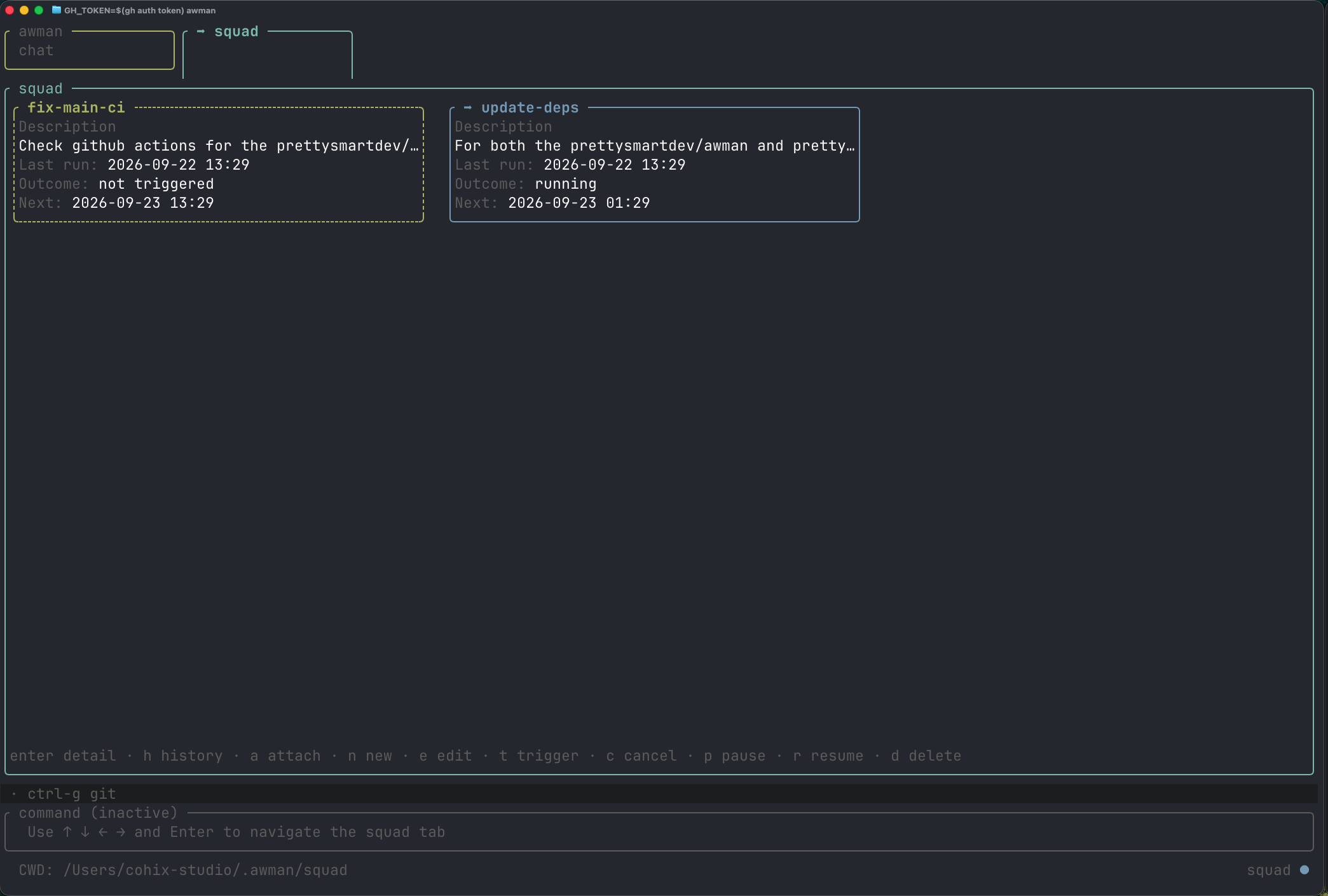
Helpers that watch so you don't have to
awman now allows you to hand your squad a task in the same words you'd use with a teammate:
awman squad start --background
awman squad add --name issue-triage \
  --description "When a new issue is opened in this repo, analyze it, draft an implementation plan, and comment the plan on the issue." \
  --interval 4h --overlay "env(GITHUB_TOKEN)"
From then on, one of your squad's agents runs regularly to check whether there is anything for it to do. Often there isn't, and it stands down after doing a thorough check. When there is, the task's leader agent plans an awman dynamic workflow for the work that needs doing and sees it through, with nobody at the keyboard.
Because an agent judges the real-world state of each task, you describe the chore instead of programming it. "When a PR has failing tests, fix them" covers the flaky one and the broken one without needing to be overly prescriptive. "When I comment /squad on an issue, do some research on my question and reply with an answer" means a quick comment from my phone is enough to hand something off. Nothing to script, no webhook to configure.
The squad I run today handles new-issue triage, fixing failing CI runs, weekly dependency bumps, and weekly security and architecture audits. None of it is the work I'm excited about doing, but it is all important and it used to be work I had to do myself. Now I sign on in the morning and the repetitive stuff has already been tackled, which leaves the day for the parts I actually care about.
Handing work off only feels good if you can monitor everything that happens. awman squad opens a TUI tab showing all of the tasks your squad is handling: full history, last run, next run, and the reason the leader gave for acting or standing down each time. From there you can run a task immediately, cancel one heading somewhere strange, or attach to the live container and interact with it directly if needed.
awman squad is not meant to take on your entire workflow, but rather take the repetitive and menial tasks off your plate so you can spend more time on important design, implementation, and product work.
Curate a skills library for you and your squad
A squad agent working unattended can't ask you for help mid-task. Whatever skills it starts with are what it has, so equipping your squad well matters more than it ever did for interactive agent work.
Until now every skill in awman was one you wrote by hand. v0.12 lets you pull published libraries of skills straight into your local collection and mount them to agents with overlays:
awman new skill --pull obra/superpowers
awman chat --overlay "skill(superpowers/brainstorming)"
You now have the ability to pick and choose the most useful collection of skills you write along with those published by others in the community without adding anything to the repos you work on. Everything is managed by awman centrally and then dynamically mounted to agent contaienrs at runtime. Nothing is added until you explicitly request it using an overlay, so you can pull a library to try it out without it polluting the context window of every agent you run. If you come to rely on a skill regularly, you can add it to your repo's .awman/config.json and every agent on the project gets it automatically. --pull-all keeps the whole collection current.
Also in v0.12
Previously, long workflow runs could die if the Claude OAuth token expired, which was an unacceptable limitation. Containers managed by awman now get an auto-refreshed credentials file that stays fresh for the life of the agent, while the refresh token never leaves the host. Another update is that any workflow step that fails no longer ends the entire run; the workflow control board opens so you can retry, step back, or step over and carry on. Finally, a new experimental ACP launch mode renders any compatible agent using awman's own UI instead of its raw terminal stream. Full details in therelease notes.
Using awman squad is the first time I have trusted agents with real work while I was not watching, but I am still learning how far I can stretch that trust. I'd reccomend starting with chores whose worst outcome is an unhelpful comment rather than an unwanted push, and widen from there. Use overlays and squad's leader guidance settings to control exactly how your squad behaves.
Source and issues at github.com/prettysmartdev/awman. More at prettysmart.dev. Feedback, issues, and contributions all welcome.